
Beyond Willpower
How addiction changes learning, motivation and choice, and how recovery becomes possible.
Addiction is a health disorder, not a moral failure.
Understanding does not remove responsibility. It replaces blame with information that can support treatment, healthier choices and greater control over our health.
About this report
This plain language report is based on 5 manually selected scientific papers published between 2010 and 2023. The selection includes review articles, a commentary based on presentations at a scientific forum, and a broad scientific update.
I selected these papers because, together, they provide information about addiction neurobiology, learning, reward, habits, stress, decision making and recovery. The paper by Speranza and colleagues is included specifically for its explanation of dopamine, reward learning and neuroplasticity rather than as a comprehensive review of addiction. [1, 2, 3, 4, 5]
This is not a systematic review and does not cover all available research. Findings from animal studies are identified clearly because animal findings cannot be assumed to apply directly to every person. Brain imaging findings generally describe average differences between groups. Interpretations and metaphors developed for this paper are also identified.
1. What the brain learns
A person can know that substance use is causing harm while still having strong learned connections between using the substance and experiencing reward or relief.
By the time a person reaches a decision point, previous experiences, familiar cues, expectations of reward or relief, stress, withdrawal and repeated behaviour may already be influencing the available options. Brain systems involved in attention, motivation and self control may also influence the decision. [1, 2, 3, 5]
A cue is anything that has become connected with substance use. It could be a person, place, smell, object, time of day, emotion or physical sensation.
Physical dependence means that the body has adapted to the substance and may experience withdrawal when use stops. Physical dependence and addiction are not the same. Addiction involves persistent substance seeking or use despite harmful consequences. Withdrawal and the temporary relief produced by using a substance again can contribute to continued use. [1, 2, 3]
The selected studies did not establish that substance related behaviour was completely involuntary. The findings showed that choices could be influenced by previous experience, learned expectations, cues, stress, withdrawal and current circumstances.
The brain changes through experience
Neuroplasticity means the brain’s ability to change through experience. Learning is possible because connections between brain cells can become stronger, weaker or more responsive. Speranza and colleagues described dopamine as an important regulator of learning, reward and synaptic plasticity, meaning changes in how brain cells communicate with one another. [4]
Repeated substance exposure and substance related learning can change brain systems involved in reward, motivation, memory and behaviour. These changes can help establish persistent patterns during addiction. [1, 2, 4]
Neuroplasticity does not work only in 1 direction. The brain can continue to change during recovery. Ceceli and colleagues reviewed studies in which some measures of behaviour, brain function and brain structure improved when substance use was reduced or stopped. The improvements were not found in every person, study or brain area. [3]
2. Dopamine, outcomes and cues
The brain learns what outcomes are likely to follow particular actions. Uhl and colleagues described a model in which dopamine producing brain cells increased their activity when an outcome was better than expected and decreased their activity when an outcome was worse than expected. [2]
These changes are called prediction error signals. The word error means that there was a difference between what was expected and what happened. It does not mean that the person made a mistake. These signals help the brain update expectations and influence later behaviour.
Dopamine is not simply a pleasure chemical
The selected papers described dopamine as contributing to reward learning, motivation, repeated behaviour, expectation updating and the motivational importance of cues. Dopamine also contributes to some forms of neuroplasticity. Dopamine does not simply measure enjoyment. Other brain chemicals and circuits are also involved, and different substances affect these systems in different ways. [1, 2, 4]
Several connected brain areas contribute to substance related learning. The hippocampus contributes to memory and context, meaning the circumstances surrounding an experience. The amygdala contributes to emotional learning. The striatum contributes to reward learning, repeated behaviour and habits. The prefrontal cortex, an area near the front of the brain, contributes to planning, evaluating outcomes, decision making and self control. These areas work together and have several functions. There is no single addiction centre in the brain. [1]
Cues can become powerful
Uhl and colleagues summarised brain imaging studies involving people with cocaine addiction. In those studies, researchers did not detect a statistically significant increase in measured dopamine after methylphenidate was given to active or detoxified participants with cocaine addiction. Methylphenidate is a stimulant medicine that was used under controlled research conditions. Participants with cocaine addiction also reported less of a high than comparison participants. [2]
In contrast, exposure to cocaine related cues was associated with increased dopamine in the dorsal striatum, which contributes to learned and habitual behaviour. Larger dopamine increases were associated with stronger reported craving. The word associated means that the findings were connected. It does not prove that the dopamine increase was the only cause of craving. [2]
Incentive salience describes the motivational importance that a cue can acquire. In simple language, a cue can begin to feel unusually important or difficult to ignore. This may help explain why a person can experience a powerful urge after encountering something connected with previous substance use.
3. Repetition and habits
Uhl and colleagues described initial substance taking in their model as voluntary and directed towards an expected outcome. A person might initially expect pleasure, confidence, energy, relaxation or relief. [2]
The authors reviewed animal experiments that examined how repeated cocaine seeking changed over time. Researchers used a procedure designed to reduce the expected value of cocaine seeking and then observed whether the animals continued seeking cocaine. This method is called outcome devaluation.
After shorter training, reducing the value of cocaine reduced cocaine seeking. After prolonged training, cocaine seeking continued despite the change in value. The researchers interpreted this as evidence that the behaviour had become more habitual. Habitual behaviour is guided more strongly by familiar cues and learned routines and less strongly by a fresh evaluation of the expected outcome. [2]
The animal studies also found that the contribution of different brain systems changed as cocaine seeking became established. The basolateral amygdala and nucleus accumbens contributed to acquiring the behaviour. The dorsolateral striatum, which contributes to repeated actions and habits, became more important after the behaviour was established. [2]
These were animal findings. They helped researchers investigate possible mechanisms but did not prove that every person with addiction followed the same progression. Koob and Volkow described a related model in which early changes involved reward and motivation systems, while systems associated with habits became increasingly involved with repeated use. [1]
The river metaphor
A well used channel is easier for water to follow. This does not mean that another route is impossible. It means that the existing route has an advantage because it has been used repeatedly.
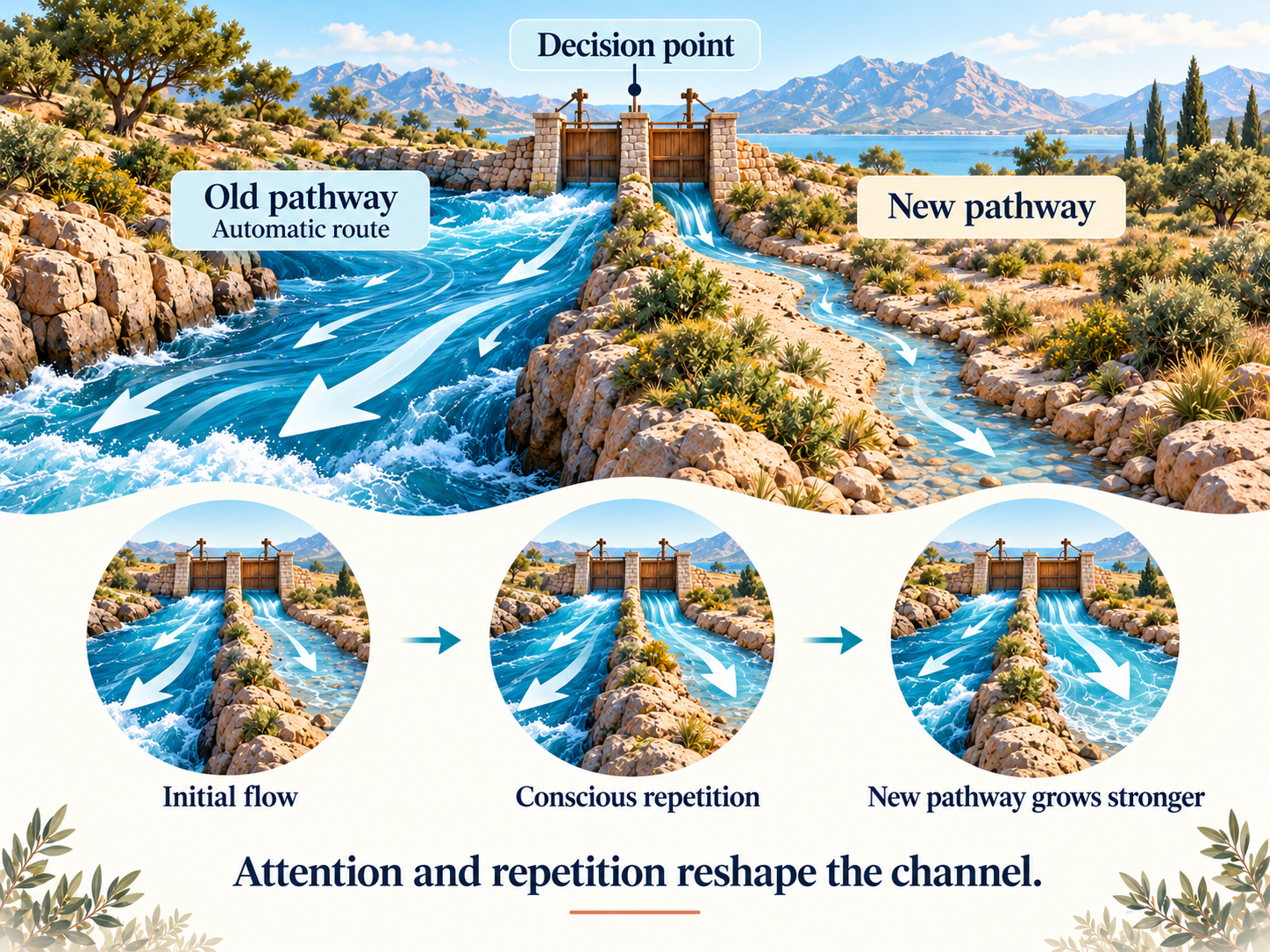
The river scene is a metaphor, not a description of brain anatomy. Frequently repeated responses can become easier to trigger. Pausing may create time to consider another response, and repeated practice can strengthen a different behavioural response. These practical interpretations were not tested directly in the 5 selected papers.
4. Why motivation can change
Koob and Volkow described a model in which impulsivity tended to be more prominent earlier in addiction, while compulsivity became more prominent later. This was a general model, not a sequence that every person experienced. [1]
Impulsivity means acting quickly to obtain an expected reward without giving enough attention to possible consequences. Compulsivity means feeling driven to repeat a behaviour even when the behaviour is causing harm or no longer produces the same reward.
Reward and relief
Positive reinforcement means that a behaviour becomes more likely because it produces a desired effect: “I use this substance because it gives me a feeling I want.”
Negative reinforcement means that a behaviour becomes more likely because it reduces an unpleasant experience: “I use this substance because it temporarily stops me from feeling so bad.” Negative reinforcement does not mean punishment. It means that an unpleasant state is reduced or removed.
Koob and Volkow reported that reward related systems became less responsive during withdrawal while stress related systems became more active. Anxiety, irritability, low mood and reduced interest in ordinary rewards could form part of this negative emotional state. [1]
Using the substance could temporarily reduce this discomfort. That relief could make the behaviour more likely to happen again, even when the substance no longer produced the same pleasure. Repeated use and withdrawal can therefore create or intensify an unpleasant state. The brain can then learn that using the substance temporarily relieves that state.
Not every unpleasant emotional state is caused by substance use. Stress, difficult experiences, physical illness and mental health conditions can also contribute. [1, 2, 5]
This helps explain why addiction is not simply repeated pleasure seeking. Motivation may shift from obtaining a desired effect towards avoiding or reducing distress.
5. The decision point
Ceceli and colleagues reviewed a model called impaired response inhibition and salience attribution. Response inhibition means the ability to stop or suppress an action. Salience means how strongly something captures attention and how important it feels. [3]
In this model, substance related cues received unusually strong attention and motivational importance. At the same time, the ability to stop a harmful response could become impaired. [3]
The authors described the prefrontal cortex as contributing to comparing options, making decisions, working towards goals, paying attention, holding information in mind, recognising errors, regulating emotions and stopping harmful responses.
Brain imaging studies reviewed by Ceceli and colleagues found average differences in the structure and activity of prefrontal brain systems between groups of people with and without addiction. Structure means measurable physical features, such as the volume or thickness of a brain area. Activity means how strongly an area or network responds during a task. These were average differences between groups. The findings did not mean that every person with addiction had every reported difference. [3]
When preference and behaviour differed
Ceceli and colleagues described an experiment involving people with cocaine addiction. Participants rated pleasant images more favourably than cocaine related images. However, participants with cocaine addiction selected cocaine related images for enlargement more often than comparison participants did. [3]
The researchers discussed this difference between reported preference and actual selection as relevant to impaired insight, meaning reduced awareness or understanding of a behaviour or its consequences. The finding did not mean that people with addiction were unaware of every decision. It showed that reported preferences and actual choices could differ.
A more useful question is not only, “Why do I not say no?” It is also, “What has made this option feel so important at this moment?”
6. Why addiction is not a moral failure
Volkow and Blanco reported that substance use disorders had historically been treated as character flaws or moral deficiencies. The authors instead described addiction as a progressive health disorder that could be treated and from which recovery was possible. [5]
The 5 selected papers linked addiction with learning, reward, stress, motivation, habits and executive control. Risk was not determined by 1 factor. Volkow and Blanco described biological influences, including genetics and development, and social influences, including adverse childhood experiences and other social conditions. These factors could contribute to vulnerability or resilience. [5]
Vulnerability means being more likely to develop a problem. Resilience means having characteristics, resources or support that help a person cope or recover.
Understanding addiction does not excuse harmful behaviour or remove responsibility for actions. It helps explain why intention alone may not be enough and why treatment, social support and environmental conditions can influence recovery.
Blame asks, “What is wrong with me?” Understanding asks, “What has my brain learned, what is keeping this pattern going and what support could help me change it?”
The second question provides a more useful starting point for owning health. Owning health does not mean handling addiction alone. It means understanding the condition, identifying the factors that maintain it, seeking appropriate support and taking part in decisions about recovery.
Interpretation: Examining cues, stress, withdrawal, expectations and habits may identify more useful points for change than blaming the person. The 5 papers did not directly test whether reducing self blame improved recovery.
7. Recovery
Ceceli and colleagues reviewed evidence that some measured changes in prefrontal brain structure and function improved when substance use was reduced or stopped. The amount and speed of change differed among studies, substances, brain areas and participants. These findings did not promise complete reversal. They showed that measurable improvement was possible. [3]
Findings from alcohol studies
Longitudinal studies followed the same people over time rather than examining each person only once. Studies involving people recovering from alcohol addiction found increases in frontal grey matter volume beginning as early as 1 month after abstinence. Further increases were measured over subsequent months. [3]
Grey matter contains brain cells, connections and supporting structures involved in processing information. At later assessments, brain scans showed a greater measured volume of grey matter near the front of the brain. The scans did not show that a new brain area had grown and did not reveal exactly which biological changes produced the increase.
Findings from cocaine studies
In 1 longitudinal study, participants reduced cocaine use by at least 10% and were followed for at least 6 months. Participants who reduced cocaine use also showed increased prefrontal cortical thickness and better visual sustained attention. [3]
Prefrontal cortical thickness means the measured thickness of the brain’s outer layer near the front of the brain. Increased thickness meant that this layer appeared measurably thicker on a later brain scan. Visual sustained attention means the ability to continue paying attention to visual information.
The findings were associated. Participants who reduced cocaine use also showed these measured changes. The study did not prove that reduced use was the only cause. Another longitudinal study found that substantial reduction or cessation of cocaine use was associated with better reward related decision making and increased volume in parts of the prefrontal cortex. These studies did not guarantee that every person would experience the same changes or follow the same timetable. [3]
Findings from a nonhuman primate study
A longitudinal study followed nonhuman primates that had self administered cocaine for 1 year. After 2 years without cocaine, many affected brain areas showed increased grey matter density. Grey matter density is a measurement obtained from brain scans. The findings suggested partial reversal of some measured structural differences. [3]
Recovery was not complete in every area. The insula, amygdala and left orbitofrontal cortex did not show statistically significant reversal. Statistically significant means that a finding met the researchers’ statistical threshold. A result that was not statistically significant did not prove that absolutely no change occurred. It meant that the study did not provide enough evidence to conclude that a reliable change had occurred. Animal findings cannot be assumed to apply directly to every person. [3]
Treatment findings
Ceceli and colleagues reviewed longitudinal studies in which reduced use or abstinence was associated with behavioural improvements and partial recovery of measured brain structure. The authors also reviewed intervention studies that reported changes in brain function, cue responses or self control related processes. These studies examined cognitive reappraisal, motivational approaches, mindfulness, selected medicines and methods that influenced brain activity. [3]
Cognitive reappraisal means learning to think about a cue or situation differently. Mindfulness involves noticing thoughts, feelings and physical sensations without immediately reacting to them. A measured change in brain activity did not, by itself, prove lasting clinical benefit. Evidence about long term effects and who benefited most remained incomplete for several approaches.
Volkow and Blanco reported clinically meaningful benefits from medicines for opioid, nicotine and alcohol use disorders, behavioural treatments across substance use disorders, and neuromodulation for nicotine use disorder. Neuromodulation means using a device to influence activity in particular brain systems. [5]
Treatment intensity needed to reflect the severity of the disorder and address other physical and mental health conditions. Available treatments also differed according to the substance involved.
Recovery experiences vary. Volkow and Blanco reported that substance use disorders are treatable. [5] Ceceli and colleagues reviewed studies that reported behavioural improvements and partial recovery of measured brain structure during reduced use or abstinence. The authors also reviewed intervention studies that reported changes in brain function and responses to substance related cues. [3]
Recovery is broader than brain imaging. Volkow and Blanco discussed substance use disorders and their treatment in relation to health, wellbeing and social functioning. [5]
What this changes
The following questions are a practical interpretation of the 5 manually selected papers. The questions were not tested as an assessment tool and cannot diagnose addiction.
Ask about the expected outcome
What has substance use provided in the past? Has it produced pleasure, energy, calm, escape or relief?
Ask what predicts the behaviour
Which people, places, objects, routines, thoughts, emotions or physical sensations have become connected with substance use?
Ask what becomes difficult to ignore
What captures attention when substance related cues are present?
Ask how habitual the response has become
How quickly does the behaviour follow a familiar cue?
Ask about the current state
Is the person experiencing stress, withdrawal, low mood, anxiety, pain or another unpleasant state?
Ask what could change the balance
Which treatment, support, environmental change or alternative response could address the person’s triggers?
The central idea
The 5 selected papers indicate that addiction is not simply about seeking pleasure. Addiction involves learning, memory, motivation, habits, stress, withdrawal, executive control and the brain’s capacity to change. [1, 2, 3, 4, 5]
These findings do not establish that choice disappears or that substance related behaviour becomes completely involuntary. They help explain why stopping can be much harder than simply deciding not to use a substance.
If you are experiencing addiction, the 5 selected papers suggest that the difficulty cannot be understood adequately as a bad choice alone. Learned connections among cues, actions, rewards, stress and relief may be contributing to the behaviour. [1, 2, 3, 5]
Recovery experiences vary. Volkow and Blanco reported that substance use disorders are treatable. [5] Ceceli and colleagues reviewed longitudinal studies in which reduced use or abstinence was associated with behavioural improvements and partial recovery of measured brain structure. The authors also reviewed intervention studies that reported changes in brain function, cue responses or self control related processes. [3]
Talking about what concerns you is the first step for recovery.
Here, you are not being asked to deny harm or avoid responsibility.
You are being invited to understand the processes involved, replace blame with informed action and take part in decisions about your health.
References
- Koob GF, Volkow ND. Neurocircuitry of addiction. Neuropsychopharmacology. 2010;35(1):217–238. doi:10.1038/npp.2009.110
- Uhl GR, Koob GF, Cable J. The neurobiology of addiction. Annals of the New York Academy of Sciences. 2019;1451(1):5–28. doi:10.1111/nyas.13989
- Ceceli AO, Bradberry CW, Goldstein RZ. The neurobiology of drug addiction: cross species insights into the dysfunction and recovery of the prefrontal cortex. Neuropsychopharmacology. 2022;47(1):276–291. doi:10.1038/s41386-021-01153-9
- Speranza L, di Porzio U, Viggiano D, de Donato A, Volpicelli F. Dopamine: the neuromodulator of long term synaptic plasticity, reward and movement control. Cells. 2021;10(4):735. doi:10.3390/cells10040735
- Volkow ND, Blanco C. Substance use disorders: a comprehensive update of classification, epidemiology, neurobiology, clinical aspects, treatment and prevention. World Psychiatry. 2023;22(2):203–229. doi:10.1002/wps.21073
Want to talk through what you’ve read? Health Coaching is a space to slow down and look at what keeps repeating.